- What I'm reading
- The art of noticing: what is nature journaling and how to get started
Paid Members: this month, you will see an additional issue upcoming about tidepooling. Stay tuned.
What I'm reading:
It seems that nature is trendy. Here are a few books about nature, some new and some old:
- The Entangled Life by Merlin Sheldrake: Nonfiction. About mushrooms and fungi, and how they permeate our world.
- A far-flung life by ML Stedman: Fiction. Set in the bush, near Perth, Australia and set in the early 1950s. The book explores many themes of identify, death, grief, memory and a right to privacy.
- How to do nothing: Resisting the Attention Economy by Jenny Odell: Non-fiction. This is an older book written during the Covid-19 pandemic. I am told she has also written another book called Saving Time. It's a stark contrast to Nir Eyal's writings. Both Eyal and Odell are SF Bay Area residents. Both write about time, attention and productivity. Odell's writings felt more reflective of my sentiments about technology and attention.
The art of noticing: how to start nature journaling
"When you collect marine animals there are certain flat worms so delicate that they are almost impossible to capture whole, for they break and tatter under the touch. You must let them ooze and crawl of their own will onto a knife blade and then lift them gently into your bottle of sea water. And perhaps that might be the way to write this book — to open the page and let the stories crawl in by themselves" – John Steinbeck, Cannery Row
I've never cut open a flat worm. I've never opened up a chrysalis to see the gooey inside. But I do appreciate the feeling of observing something in nature and to find the story. As Steinbeck suggests, we need to sit in stillness and allow nature to unfold in front of us.
You don't have to be a scientist to notice the natural world around you. It simply starts with your five senses, an open mind, and a willingness to record what you observe. There is an additional benefit: nature exposure is mood boosting and healing.
To start, step outdoors and into your neighborhood. Look for any critters, plants or birds that you see that spark your curiosity. Take a plain sketchbook and a pen with you to record what you see. I often suggest that you want to take a sketchbook with a grade of paper that you feel good using, and not necessarily "the best" paper.
Developing a practice of wonder and noticing takes time. It is skill building with very strong benefits to your memory. Through this practice, I encourage multi-modal expression through words, numbers and pictures. As you build new skills, you will learn to test your edges, and explore where you feel most fluent, and where you want to stretch further.
Some purists will say that nature journaling must be done outdoors. It must "feel good" in the wild to be real nature journaling. I am not a purist, because I remember what it is like to be a beginner. Also I find that I have great discomfort with extreme heat or extreme cold.
Find the "near and here" first. Eventually, you will become more comfortable in more ambiguous, outdoor situations.
Let's take a moment to practice this. Take a close look at this sea urchin in the video. This was sampled from the boat docks for Half Moon Bay for a marine biology lab (and returned to the water afterwards).
Video: An active purple Sea urchin in saltwater catching prey with its tube feet.
What do you notice about this sea urchin? What does it remind you of?
The phrase "I notice..." is a helpful one to record observations of what you see, hear, smell, etc...this single phrase is powerful and helpful to record your observations:
The sea urchin was very much alive (and maybe hungry!). It was amazing to see how it moved freely, unaware of any human observers.
There are many ways to practice noticing. Here are a few ways to get started.
1) Create a critter collection in your sketchbook.
While aboard the Big Blue Boat with docents of the Marine Science Institute in Redwood City, Calif, our docents showed us how to trawl the bay waters to collect biology samples. The collection of species in the sketch below are critters that we discovered that day. This included: a Korean Shrimp, some type of decorator crab, a nudibranch (pronounced nu-dee-brank), basically a type of sea slug, and an Eastern mud snail.
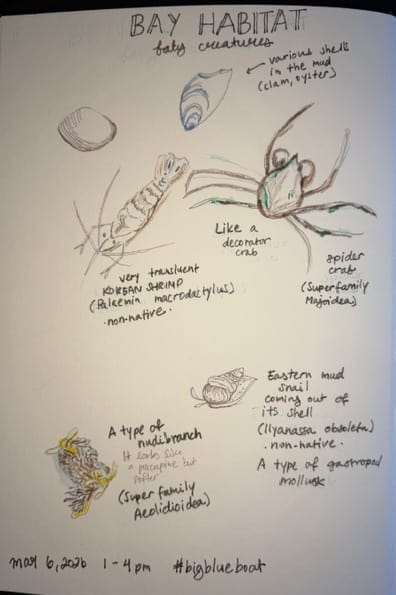
You don't have to go on a far-off boat trip like this. Remember, we want to start with the near and here. This example is simply one that shows you how I followed my curiosity.
If you are completely new to this, it might be hard to be outdoors and record everything that you see. That is a question that I often hear: "how do you choose what to draw?" Try to focus your drawings what you love the most. In my case, I really loved the nudibranch the most. It was so delicate, gaudy and almost fluffy.
If you find yourself distracted by other critters in your wider environment, but you don't want to draw it, you can add a bullet in the margin.
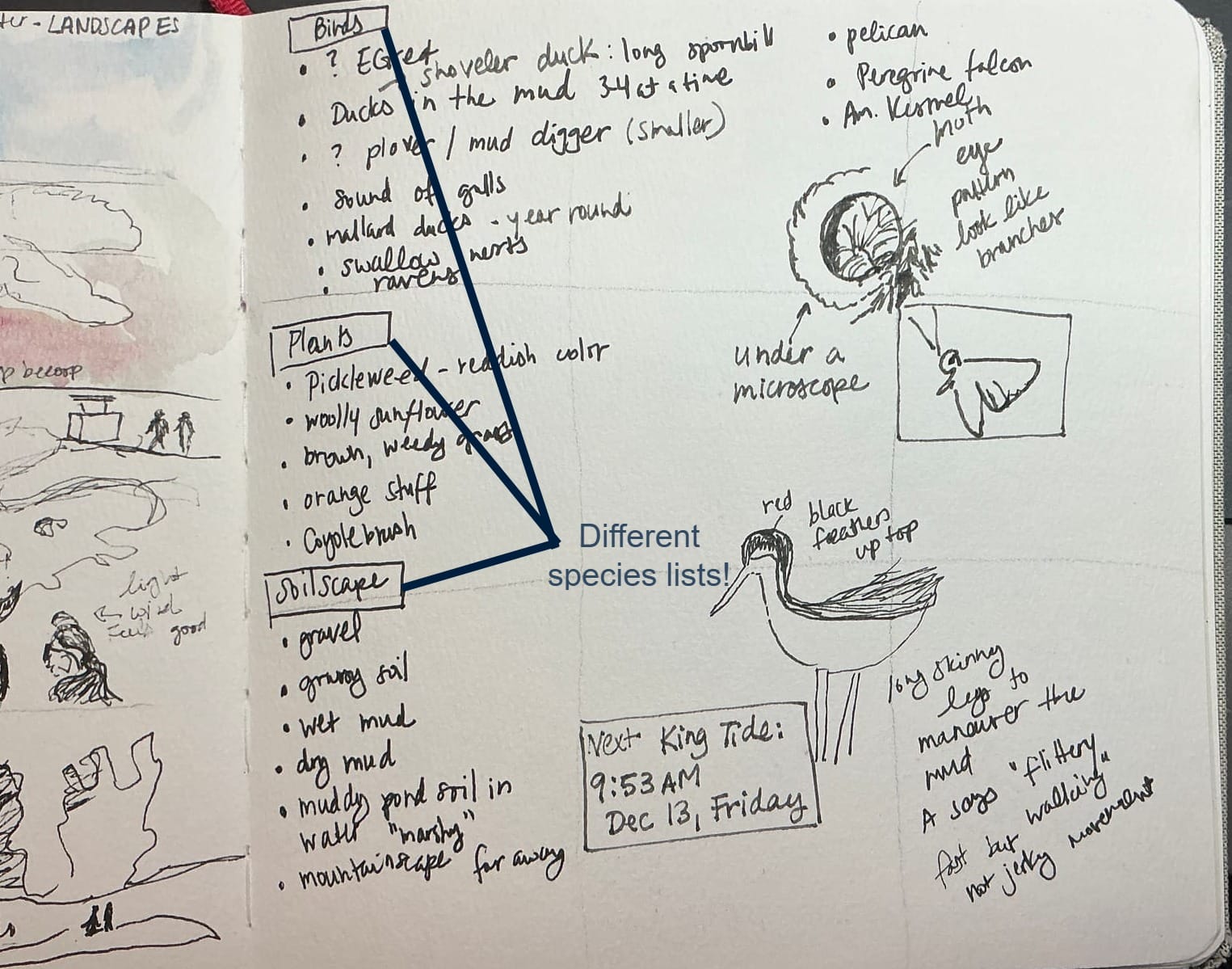
These bulleted lists, sometimes called "species lists" are helpful for noting different critters, plants or even types of soil. Another way to think about them is as lists of curiosities that you want to learn more about. As you continue to practice nature-based journaling, you may find yourself revisiting the species list again for new drawing or journaling inspiration. Maybe, one of those critters will become the focus of your curiosity later.
When creating species list, try to avoid making a checklist about everything that you see. The goal is mindfulness and presence. This is not an exercise in maximization.
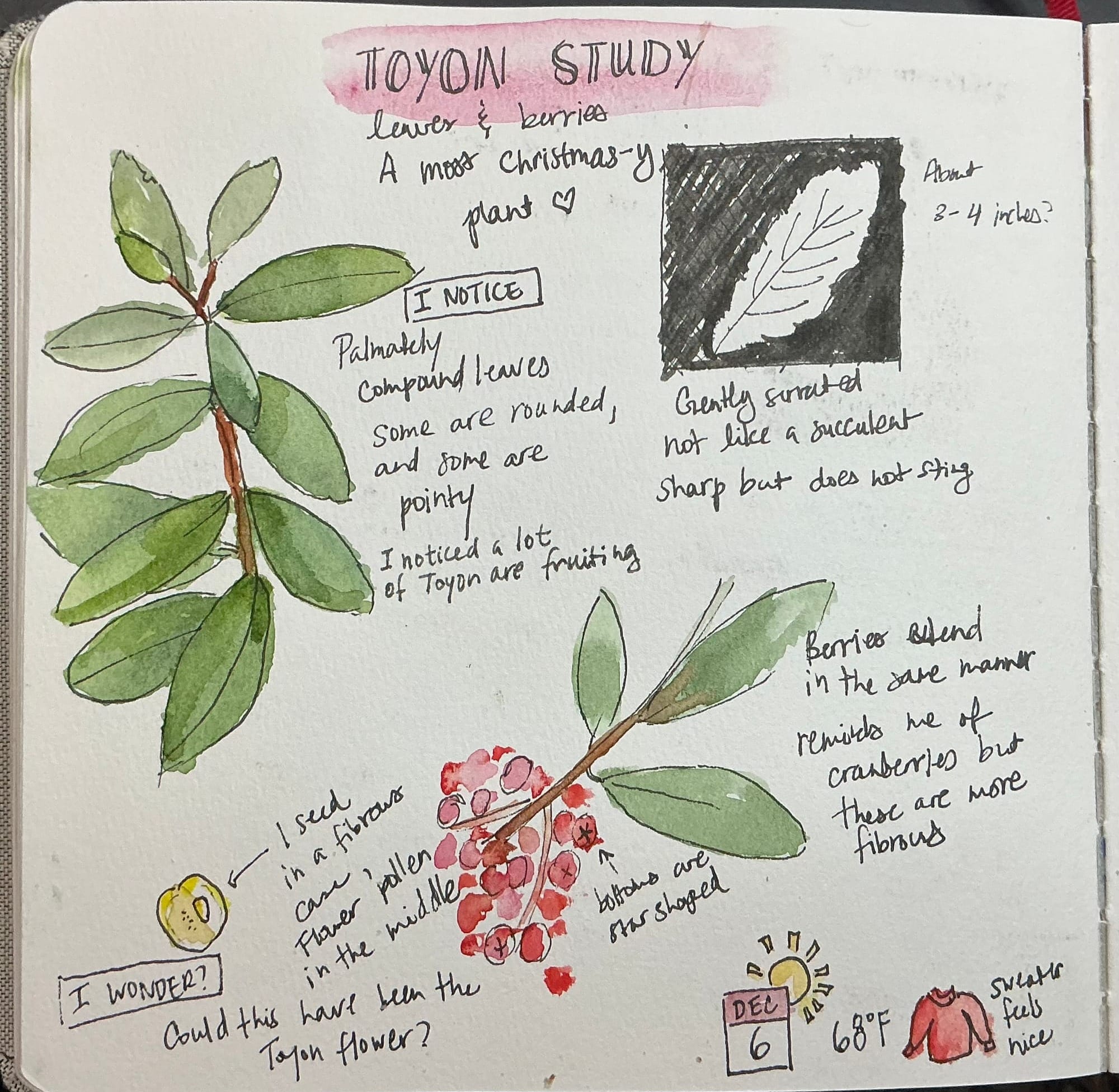
2) Practicing zooming in from different angles. Making a collection of species is fun, and simple. But can you zoom in on just one? Drawing a plant or a leaf is the simplest way to start. Can you look at it from different angles? For example, the leaf may have a certain shape, alternating leaves or different shapes of flowers.
3) Try drawing a creature that is frequently in motion (or try from a live cam). Drawing from motion is one of the harder skills to acquire. Many of us build up this fluency by first drawing plants or animals that are in stillness.
You can find live cams available at Explore.org, and they are fun to watch. Some live cams lend themselves to being better for sketching practice than others. If you try it, set the video to less than 1x speed if you want a slower pace, but resist rewinding.
Here's an example of an Allen's Hummingbird at a bird feeder, drawn from live cam (which is no longer available, but you can try this one here featuring a hummingbird nest. Bonus: it has calming music.)
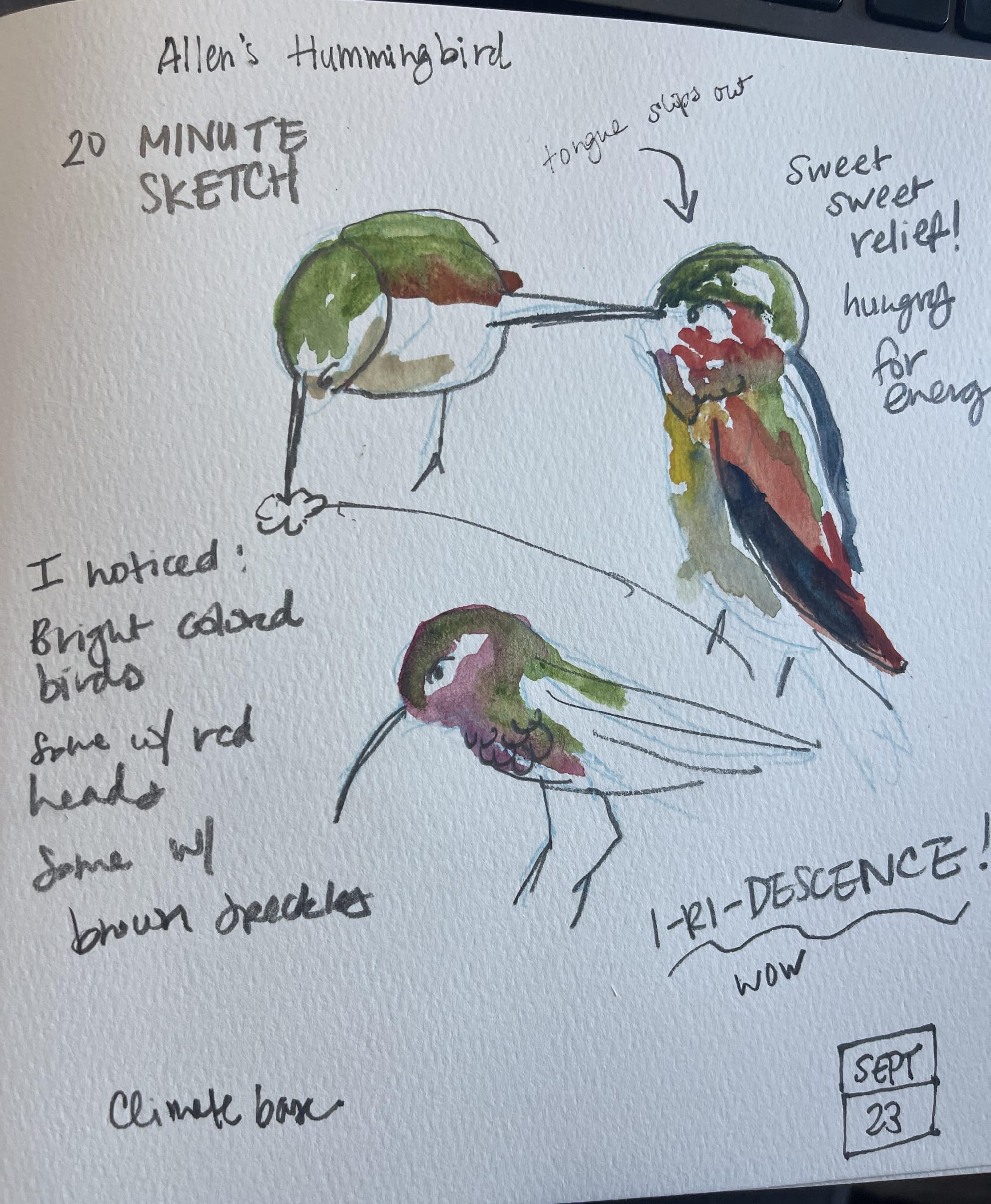
In this case, I was not focused on the fine details of the bird's feathers. The goal is to express the direction of the movement. When you watch the video for a while, you may notice repetitions in the bird's behavior, whether that is in the head movements, feeding or in the rest poses. Don't worry about how it looks. The translation is meant to be quick and imperfect. Remember, enjoy the process and push away the thought of arriving at a result.
If you have questions about getting started, or if there's an idea you want to share, please email me.
This newsletter is made as a labor of love from me to you. If you are not yet a paid subscriber, please consider subscribing to support my work.
Or leave me a tip.
Subscribe to my newsletter to get the latest updates and news